Showing posts with label rope. Show all posts

Tuesday, 5 July 2011

Rope and Leaky Watering Can

KorganIconFound out my watering can leaks, a month ago or so. Took advantage of this: tied up the can above our basil pot and now it has a drip feeder.

Note: This isn't a perfect solution. It wets the leaves which is almost never a good thing, but it's been hot outside so I have no concern about mould growth. Other than that it's great and it's nice to be able to quickly fill up the can and walk away letting it get on with it. And it's nice to use rope. And it looks unusual.

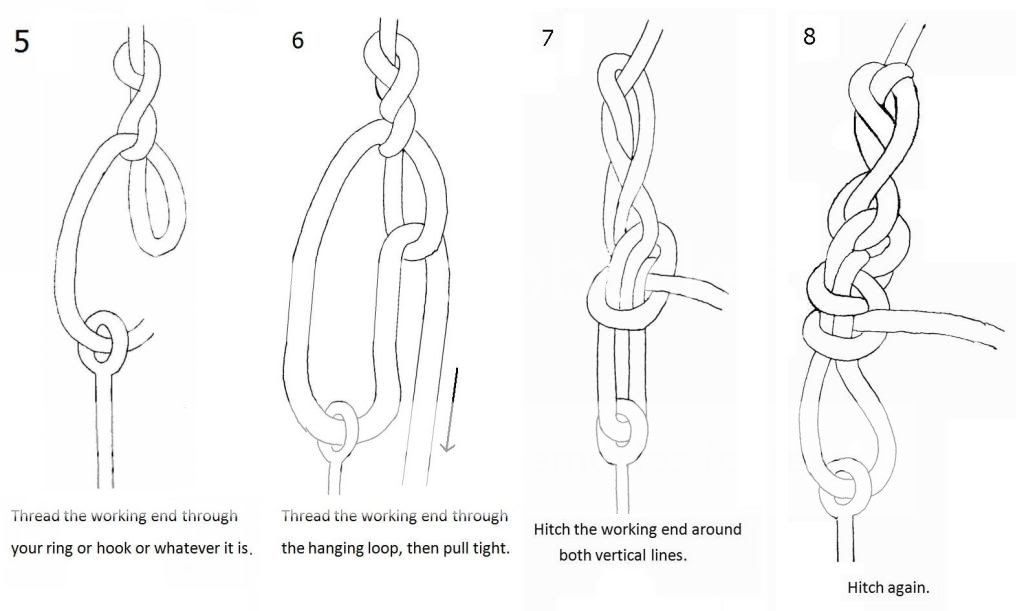
Rope is attached to bars with an Evenk Hitch, can is pulled up with a Trucker's Hitch (with a #1058 loop), finished off with wraps. I usually never use wraps because they're such a hassle to undo even though they look good, but I can get away with it this time because I'm using the Evenk: if I need to take this down I just pull on the end.

Thursday, 9 June 2011

Knot Godhood

KorganIconA while back on the IGKT forum, I made a list of knots to learn, with the idea being that it be used for teaching purposes, and to enthuse rope newbs.

Here is the document.

The preamble gives you the idea:
You are beginning your journey from unskilled peon to Knot God. The journey may be long and challenging, but each technique you learn brings you closer to Knot Godhood. Only by unanimous decision by the Council of Knot Gods can the title of Knot God be bestowed. Those who wish to become a Knot God must commit the Knot Code to memory and appeal to the Council. Once you become a Knot God, your status as such may not be revoked unless by unanimous decision by the Council.

The Knot Code follows after that, which includes a list of 112 knots including hitches, loops, bends, splicings, lashings, coils and bindings.

It makes a fun challenge out of something that may be tedious and dull if you're made to do it.

Friday, 24 September 2010

double splayed loop in the bight (ABOK #1100)

KorganIconThis is an excellent double loop knot. Buff your brakes off, lazy.


If you already learned the lineman's loop/alpine butterfly loop (ABOK #1053) then you already know most of this knot too.
So why not go ahead and learn it? Click on images for larger images.


Instructions, if you need them:
  1. Make a bight.
  2. Twist the bight.
  3. Twist the bight again.
  4. Fold the top loop down.
  5. Feed it into the centre loop from behind.
  6. Feed the left and right loops into the centre loop.
  7. Pull the centre loop downward.
  8. Tighten and dress the knot.

Lineman's Loop/Alpine Butterfly Loop

KorganIconThe Lineman's Loop, also known as the Alpine Butterfly Loop (ABOK#1053), is used a bunch in climbing to make a loop in the middle of a rope. It's a good default loop knot. Despite its popularity, I couldn't find a good, specified breakdown online of how it's made. So I made my own. Here it is. Click on images for larger images.


Instructions if you need them:
  1. Make a bight.
  2. Twist the bight.
  3. Twist the bight again.
  4. Fold the top loop down.
  5. Feed it into the centre loop from behind.
  6. Pull tight and dress the knot.

Monday, 20 September 2010

Rope & Knots

KorganIconYou can do a lot with rope. If you have a mechanical problem in the garden or your house, I'm pretty sure rope can handle the strain of the problem.

I think it's good to know how to work with rope. I think Urban Homesteaders should know how to work with rope, specifically.

Knots categorise pretty readily. There are bends, loops and hitches.
  • bend: to join two ropes together.
  • loop: well that's obvious.
  • hitch: to attach a rope to an object, usually a post or a ring.
There are thousands of different knots. They've evolved over roughly a squillion years. Some have more than one name. Some are called knots when they really should be called hitches, that kind of thing. If you come across a knot that has more than one name, just remember the one that you prefer.

There are plenty of beautiful dorks out there who know hundreds of knots. I know enough to give me options. Here is a list of good knots to know:
You might want to learn all of these. You might only want to learn one from each category. But I would recommend trying a few from each category to get the idea. As well as the decorative knots, there are fishing knots, lashings and bindings, whippings and splicings. If you're looking for areas to apply what you learn then check out climbing sports, martial arts, survivalist stuff and shibari. I would recommend a couple of books. Knot Know-How is one of the better books that got me started fast. It doesn't bog you down and it will teach you the basics very quickly. On the other hand, if you want to know almost everything about knots, their history and applications, then you want to get your hands on a tome called Ashley's Book of Knots. This is an encyclopedia of knots with historical info. It's an awesome book to browse through and open in random places. You can get that on Amazon too, but if you'd rather spend that $50 on food or weed (very wise), then there is a torrent file of the book online so you can read it for free.

If you know absolutely nothing about knots, start at the top of any list and work your way down. The ones at the beginning of the lists are the easiest. But to be honest, most of these are easy. If they weren't, I wouldn't remember them.

Thursday, 3 December 2009

Pulleys and Pistons

KorganIconI have a fetish for pulleys. I find pulleys and rope very interesting. Anything involving rope usually interests me. No idea why. I know about 40 different types of knot, and I know how to bind and suspend a woman securely from the ceiling.

Last week I started to sketch out some ideas for good-looking configurations of pulleys and rope. No real use for it, just to play.
(click on any image for larger image)


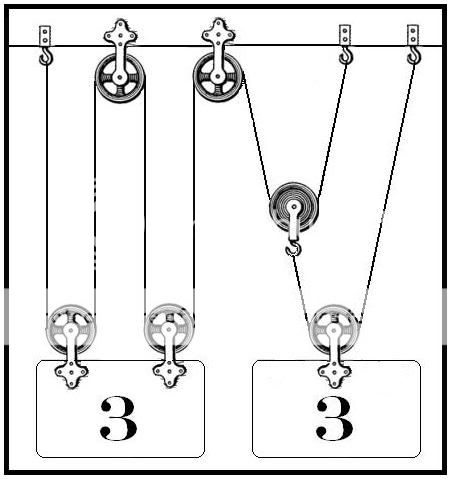
This is one way you can rig pulleys to allow a small helium balloon to lift a 1 lb weight (assuming the ropes and pulleys weighed nothing). The second sketch is two equivalent pulley systems joined together. The left side uses fixed pulleys to give a 1:4 advantage; the right side uses a movable pulley to give a 1:2² advantage. So they balance.

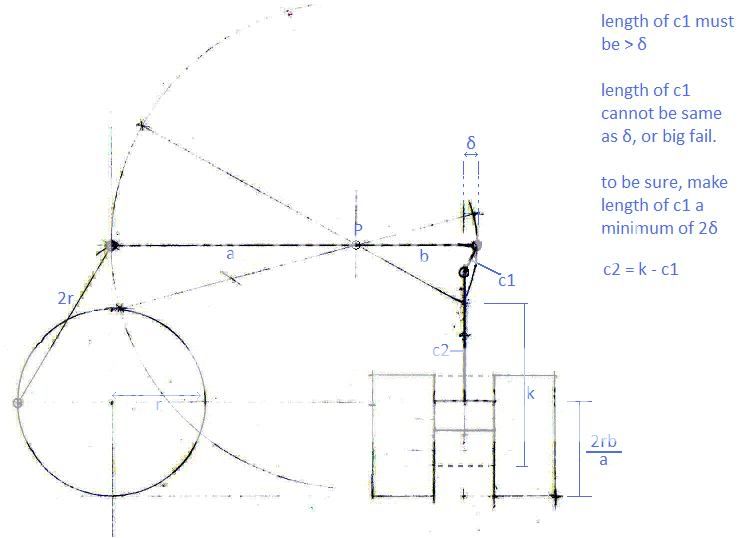
So I started reading about pulleys, and then I read about simple machines. I decided I wanted to design a wind-powered water pump that fits onto a standard 55 gallon food-grade barrel. This barrel is a rain barrel. The idea is that the water will be pumped to a filter, and then drain back into the barrel. With the wind powering it, the barrel will be self-cleaning. The filter will be easily removed, cleaned and replaced to continue filtering. Not only will this filter the water with no effort, it should also look awesome.

So that's where I started. I watched some videos, read about simple machines and sketched a few ideas. Then I really got into it. I figured four ways to get a fan to pump a piston.

DIRECT ROTOR TO PISTON CONNECTION

ROTOR TO PISTON VIA LEVER

ROTOR COG TO PISTON COG TO PISTON

ROTOR COG TO PISTON COG (VIA BIKE CHAIN) TO PISTON

I also figured out something that took me a while to understand. A yaw. A yaw on a wind turbine is the big wing at the back of a wind turbine that turns the turbine around so that the blades always face upwind. I couldn't figure out how to connect the turbine to a piston pump while at the same time allowing the turbine to rotate 360°. I figured it out today and did a sketch.

MECHANICAL YAW MECHANISM

The yaw wind turbine sketch isn't to scale but everything is there. I don't know the proper symbols used on professional technical drawings but hopefully it's clear. The thing in the centre that looks like a box of marbles is a type of joint that allows the piston connection to rotate above the 'box of marbles', but not below it. The other 'box of marbles' above it is to allow the entire top part of the machine to rotate. Hope that makes sense.

All these wind turbine sketches are a simple one turbine, one pump setup. I had other ideas for water pumps that pump in both directions, a couple of different ways to connect 2 pumps to one wheel, and combining those ideas together to get two double pumps connected to one wheel. I haven't sketched them yet though.

I haven't included in the sketches the valves you require for the piston to become a water pump. There should be two one-way valves (or check valves) attached to the piston at the base, one that only allows water in from the water supply, and one that only allows water out to where it's to be pumped. I was going to make these but I think bought ones would be more reliable, and their reliability is crucial.

I think this level of mechanics was probably taught in many schools to young children, but I never did this at school, so it's new. Learning a new mechanical technique is like finding a different type of Lego block, and it introduces an asston of new permutations.

Sunday, 11 October 2009

TRUCKER'S HITCH

Use this knot when you need to tighten a rope to hold something down like a tarpaulin or to secure items in the back of a truck. I used three to hitch up and tether down my rain gutter. Click on images for larger images.


This knot can also be used as a crude pulley system with a 3:1 advantage if you ignore the massive amount of friction. I did this when I hitched up the HPS light in my growroom.

There are a few versions of the trucker's hitch, all of which are concerned with how the loop in pic. #3 is formed. One version uses a figure-of-eight loop, another uses a slipknot. I prefer this version because it's easier to untie. There's no knot to jam, the twist simply untwists when you untie it.

Sunday, 4 October 2009

New Gutter

The wind was pretty insane yesterday. It killed my water bottle guttering. I posted on Freecycle this morning for some guttering or a length of pipe. I got a response within 10 minutes. Someone in Northfield had a 2-metre long pipe. I went to pick it up, hitched it to my bike and cycled home. Bicycles are good.

I used a jigsaw to cut the pipe, the opening I made to 2 radians. Everything else was rope work. This new pipe works far better than the Evian bottles.


The gutter is attached to the shed with trucker's hitches. Also, I tethered the gutter to the compost heap with another trucker's hitch just in case the winds come back. I tethered the filter frame to the barrel with some hitches.